February 27, 2025
📖 Starred Think less, ship more by Cassidy Williams
This is a mirror of my tweets in an attempt to follow the indieweb movement.
February 27, 2025
📖 Starred Think less, ship more by Cassidy Williams
February 26, 2025
📖 Starred Speeding up the JavaScript ecosystem - Rust and JavaScript Plugins by Marvin Hagemeister
📖 Starred A Million Little Secrets by Josh Comeau’s blog
February 25, 2025
📹 Starred I Built a Device That Randomly Orders Me a McDonald’s Meal by Unnecessary Inventions
February 24, 2025
📹 Starred Tamagotchi CD-ROM: The 1997 Digital Pet on PC by LGR
February 23, 2025
If you take just one thing away from this article, I want it to be this: please build your own website. A little home on the independent web.
It feels like we’ve lost this decades-old art form; the individuality of design and the uniqueness of content you used to see on these webpages. The notion of experimenting with HTML and CSS without worrying about something looking weird or out of place. The beauty of a website built by a person, because they wanted to.
So, once again my digital call to arms: build your own website. Make it fun. Make it pointless. But most importantly: make it yours.
Damn i could almost quote the entire article. A must read on this times.
February 23, 2025
📖 Starred This page is under construction by localghost.dev
📖 Starred Bunny jumps again by Muffin Man
📖 Starred Mr. Foot by War and Peas
February 21, 2025
📹 Starred ACTUALLY Running Windows XP on an Apple TV! by Michael MJD
February 20, 2025
📖 Starred In a Meeting by War and Peas
February 17, 2025

I found this website called Floor796 and its AMAZING, it rememebers me of the good old days on the internet. Amazing, i love it.
February 17, 2025
📹 Starred The Ozempic Problem by MeatCanyon
📹 Starred ALWAYS reach the last Pringle in the can now. by Unnecessary Inventions
February 16, 2025
📖 Starred One Hour by War and Peas
February 15, 2025
📹 Starred The Snackuum is like a vacuum for your snacks. by Unnecessary Inventions
📹 Starred American Style Chopsticks by Allen Pan - Sufficiently Advanced
February 14, 2025
📹 Starred Juegos donde la cámara es el enemigo by Guinxu
📖 Starred https://lizclimo.tumblr.com/post/775404775042940928 by Hi, I’m Liz
February 13, 2025
📹 Starred How Cracked Python Code Looks Like by PwnFunction
📹 Starred I made a zipper to make me decent. by Estefannie Explains It All
February 12, 2025
📖 Starred https://lizclimo.tumblr.com/post/775218839961174016 by Hi, I’m Liz
February 11, 2025
📹 Starred how does this keep happening? by Low Level Learning
February 10, 2025
📖 Starred Teabag Business by War and Peas
February 9, 2025
📹 Starred Liar, Liar, Pants on fire! by I did a thing
February 8, 2025
📖 Starred The Wachowskis and the Hacker as a progressive archetype by datagubbe
📹 Starred Can I fix Zelda’s UI using Unity? by Mark Brown
📹 Starred Tried shooting stop motion with Kinder Toy.【ChinaLui】 by Animist
📖 Starred A well-known avatar URL would be dang cool. (#blogPost) by Stefan Judis
📹 Starred I Built an Entire Fantasy Street in my Bookshelf by Nerdforge
February 7, 2025
February 7, 2025
Frameworks are lame. I’m just looking for a few libraries to build a website. Why does everything have to be a lifestyle choice?
Every time I have to run a CLI tool to initialise a framework I cry a little inside. My codebase is 100 megabytes and I’ve yet to write a single line of code. My project’s root directory is littered with JSON, YML, and dot files.
From Framework-mania is running wild! – David Bushell – Web Dev (UK)
February 7, 2025
📖 Starred https://lizclimo.tumblr.com/post/774773082460225536 by Hi, I’m Liz
📖 Starred Why is everything binary? by Webbed Briefs
📖 Starred Framework-mania is running wild! by David Bushell
February 6, 2025
The need for prompt engineering, on the other hand, puts us back on square one of computer use: the pesky old conundrum of a human user having to think like a computer, instead of the other way around.
A modern chess engine can easily outplay even the top ranked chess players of the world. It can be useful for practice and even developing new styles of play, but using one in a chess tournament is considered cheating. Such use is considered cheating for the same reason it’s also considered uninteresting: Humans want to watch human feats. To most people these days, a computer playing chess comes off as an extremely computery activity. Everyone understands that chess is a closed - albeit complex - system. Everyone also realizes that a modern computer can make deeper, faster and better predictions than any human is capable of. It isn’t interesting, impressive or entertaining - at least not the same way a 12 year old human chess prodigy is.
A computer that can detect a certain type of disease is of course more interesting and beneficial than a highly competent chess engine, and is going to be accepted by the vast majority of humanity as something good. It’s not cheating, it’s helping. Yet, it’s not much to hang a bunch of hype on: Like with a chess engine, or halfway decent machine translation, it’s simply a computer finally doing one of the many things we’ve always been told they should be able to. A one trick pony, basically just another piece of medical software, more like Word or Excel than a thinking machine.
This also applies to self-driving cars. Driverless vehicles in closed systems have been in use for a long time. The Copenhagen Metro, for example, has been in operation since 2002 - but like a chess engine, it isn’t “AI”: it’s simply “automated”. Currently available software may very well make human drivers both more comfortable and safe, but the hype has promised completely autonomous cars reliably zipping about in rush hour traffic.
If we’re going to be able to use LLMs to replace certain professions, they must at the very least match the average human, yielding consistent, reliable and reproducible results while making fewer and less costly mistakes. And, they should of course be capable of this without extensive and tedious prompt engineering. The question of responsibility and liability is a pressing one here, too.
I may, of course, be completely wrong. Perhaps we’ll all soon be replaced by a handful of very small shell scripts interfacing with a distant AI’s API. But, deservedly or not, it seems more likely to me that winter is coming.
February 6, 2025
I’m going to quote Ted Chiang again. He proposes that a more accurate term is applied statistics. I like that. It points to the probabalistic nature of these tools: take an enormous amount of inputs, then generate something that feels similar based on implied correlations.
I like to think of “AI” as a kind of advanced autocomplete. I don’t say that to denigrate it. Quite the opposite. Autocomplete is something that appears mundane on the surface but has an incredible amount of complexity underneath: real-time parsing of input, a massive database of existing language, and on-the-fly predictions of the next most suitable word. Large language models do the same thing, but on a bigger scale.
February 6, 2025
📖 Starred Is Winter Coming? by datagubbe
📖 Starred “Web3” and “AI” by Jeremy Keith (Articles)
📖 Starred Mental Health & Football by Dan Davies
February 4, 2025
📹 Starred the backdoor in this heart monitor is TERRIFYING by Low Level Learning
February 3, 2025
📖 Starred Sunscreen by War and Peas
February 2, 2025
February 2, 2025
📖 Starred Alien Bacteria by War and Peas
📖 Starred Gnome Files: A detailed UI examination by datagubbe
February 1, 2025
📹 Starred Win4Lin - Running Windows on Linux… 2000s Style! by Michael MJD
📖 Starred Entertainment as Code: Premier by whitep4nth3r.com RSS Feed
📹 Starred I Tattoo My Friend with a 3D Printer by Emily The Engineer
📹 Starred ¿Es posible crear Doom con filtros de TikTok? by Guinxu
January 30, 2025
Contrary to oft-repeated wisdom, the internet isn’t written in ink. Physical ink on paper is often a far better method for carrying data forward into the future. Manuscripts that are hundreds and even thousands of years old are still with us, and still being discovered every day. Will the same be true of our own data a hundred years from now?
Physical collections benefit from their form: by taking up space in the real world they demand attention and care. Digital collections more easily fall into the trap of “out of site, out of mind”. How many online services have you signed up for, added data to over time, and then later forgotten about? How much of our data, the traces of our lives online, are permanently lost?
It’s amazing how fragile we’ve let our data become.
Managing our data has only gotten more difficult as personal computing has gotten more sophisticated. So much of our digital lives have moved from our machines and into the cloud. Our documents, photos, and music used to exist on our devices where they could be backed up and preserved, but now they exist more and more in privately-owned corporate silos.
Our computers should be databases! We should be able to script them, access them using browser APIs, browse them via a first party application, etc. They should accrue data and knowledge over the course of our lifetimes, becoming more useful as we use them. They should be ours, something we can control and back up and preserve long after we’re gone.
All of our emails, recipes, playlists, text messages, Letterboxd reviews, TikTok likes, documents, music, photos, browser histories, favorite essays, ebooks, PDFs, and anything else you can imagine should be something we can own, organize, and eventually leave behind for those that come after us. An archive for each of us.
From We could all be archivists | Chase McCoy
I couldnt agree more with all its said in this post. I was highlighting almost all paragraphs.
January 30, 2025
📖 Starred We could all be archivists by Chase McCoy
📖 Starred Time Scales by Jonathan Snook
📖 Starred 80 years ago by Christian Heilmann
📖 Starred Derpify.js is now on npm and GitHub – a tool for these trying times… by Christian Heilmann
📹 Starred some of the worst API security i’ve EVER seen by Low Level Learning
📹 Starred can you buy expired hacking domains? by Low Level Learning
January 29, 2025
📹 Starred Dianna stands for the first time in 2 years! by Physics Girl
📹 Starred Equis Men llenando la Pelopincho by Jonadibujos
📹 Starred About Elon Musk’s "My heart goes out to you" gesture… #shorts #bodylanguage #misunderstood by Christian Heilmann
📹 Starred That’s why we wear glasses 👓💥 #subtleforeshadowing #engineering #explosion by the Hacksmith
📹 Starred Clones - Inkscape Inkdrop by Martin Owens
January 20, 2025
User adoption doesn’t work if it’s forced; it has to come from a genuine user belief that the new feature can help them achieve their goals. And it certainly doesn’t work if the feature actually creates a worse user experience and degrades the quality of the product.
Google implementing AI search results has led to countless examples of misinformation, factual errors and hallucination. Google was already excellent at ranking information, guessing the intent behind a search phrase and modifying its results accordingly.
But in my opinion, the tech industry desperately needs less disruptive new shit for the sake of innovation and more listening to the actual problems users are facing out there.
January 20, 2025
📹 Starred Guide Lines - Inkscape Inkdrop by Martin Owens
📹 Starred Why can’t you multiply vectors? by Freya Holmér
January 19, 2025
We put so much pressure on ourselves to be continuously productive. But we all know, deep-down, that this is an unsustainable, and frankly, highly unenjoyable way to live.
We know we need the rest, and yet we feel guilt. We feel shame. We berate ourselves for not being able to fully submit ourselves to our labour. We apologise for not getting that thing done, even though there was no arbitrary deadline.
Productivity and progress is not only measured by deliverables, such as lines of code, features, or blog posts. You are more than what you produce. You are your ideas, your thoughts, and your actions.
January 19, 2025
📖 Starred Mysterious Box by War and Peas
📖 Starred Work is meaningless, and it almost killed my husband by whitep4nth3r.com RSS Feed
📖 Starred A story about a coat by whitep4nth3r.com RSS Feed
📖 Starred It’s OK to have a slow day by whitep4nth3r.com RSS Feed
📖 Starred Your live coding stream does not need a bigger audience by whitep4nth3r.com RSS Feed
📖 Starred I conducted a community survey and here’s what I learned by whitep4nth3r.com RSS Feed
📹 Starred The Making of LEGO Island - DOCUMENTARY by MattKC
January 18, 2025
A beautiful visualization of turing machines. I knew Sam because of his Bloom filters posts and they all are a treasure to look at.
January 18, 2025
📖 Starred https://lizclimo.tumblr.com/post/772958410398449664 by Hi, I’m Liz
📖 Starred Why can’t you multiply vectors? by Freya’s Substack
📹 Starred major vulnerability found in rsync (does it matter?) by Low Level Learning
📖 Starred Jacquard 02 · Tracking provenance by Ink & Switch
📖 Starred Turing Machines by samwho.dev
📖 Starred Designing better target sizes by Ahmed Shadeed
January 17, 2025
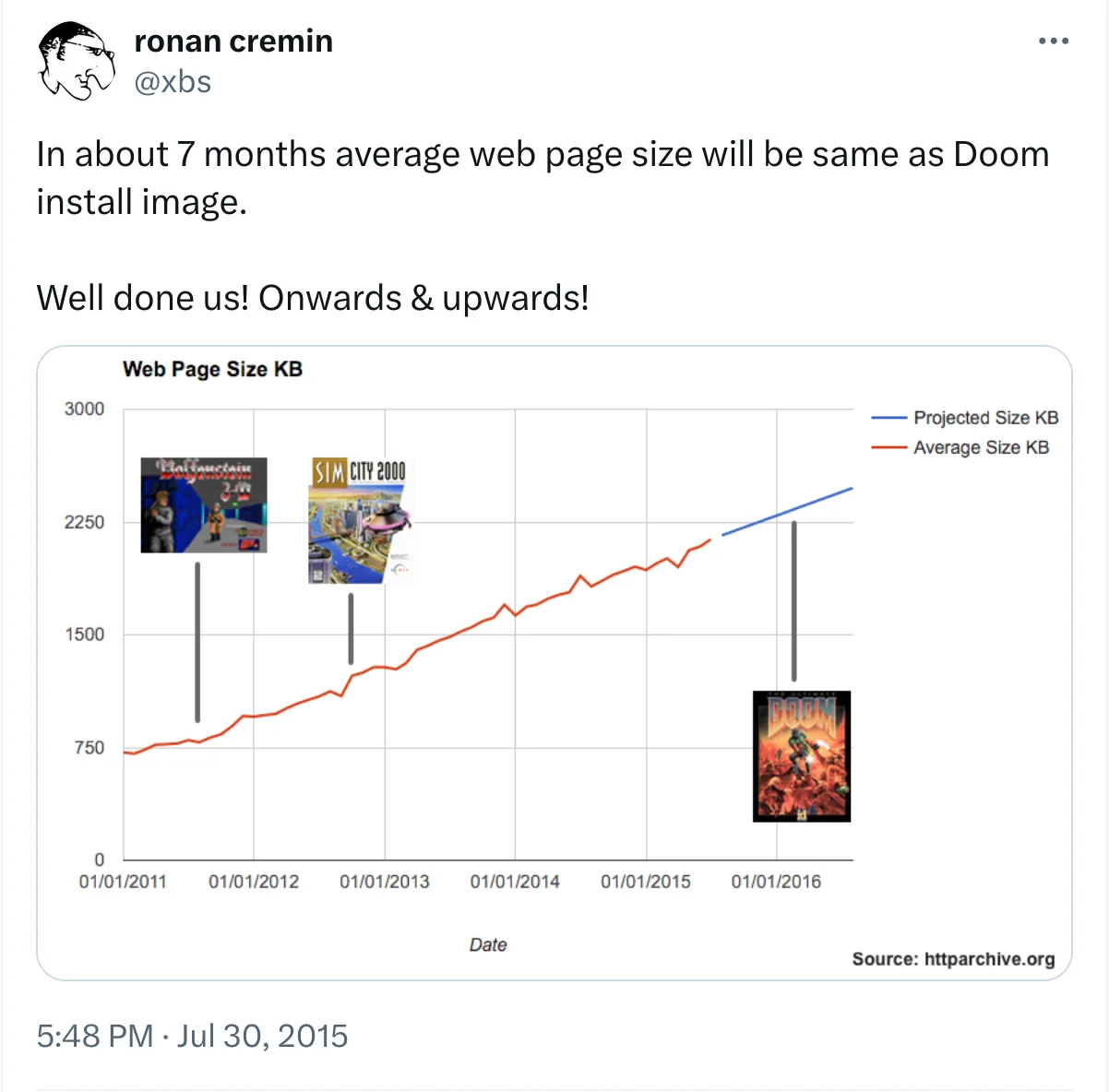
Look how cute! In 2015 average web page size was approaching shareware version of Doom 1 (2.5 MB):
Well, in 2024, Slack pulls up 55 MB, the size of the original Quake 1 with all the resources. But now it’s just in JavaScript alone.
For a chat app!
January 17, 2025
There’s a wonderful article by Sebastian Bensusan: “We need visual programming. No, not like that.” (the dot is part of the title ¯\_(ツ)_/¯).
In it, Sebastian argues that we shouldn’t try to replace all code with visual programming but instead only add graphics where it makes sense:
Most visual programming environments fail to get any usage. Why? They try to replace code syntax and business logic but developers never try to visualize that. Instead, developers visualize state transitions, memory layouts, or network requests. In my opinion, those working on visual programming would be more likely to succeed if they started with aspects of software that developers already visualize.
January 17, 2025
📹 Starred Tried shooting stop motion with Kinder Toy.【Coretoys】 by Animist
📖 Starred Patchwork 10 · Beyond prose by Ink & Switch
📖 Starred Patchwork 06 · Simple branching by Ink & Switch
📖 Starred Patchwork 05 · Edit groups by Ink & Switch
📖 Starred The Datagubbe Survey Response Survey by datagubbe
📖 Starred https://lizclimo.tumblr.com/post/772950213684068352 by Hi, I’m Liz
📖 Starred Understanding the JavaScript Modulo Operator by Josh Comeau’s blog
📖 Starred JavaScript Bloat in 2024 by tonsky.me
📖 Starred Where Should Visual Programming Go? by tonsky.me
📖 Starred The value of a prototype is in the insight it imparts, not the code. by Addy Osmani
January 16, 2025
In other words, the web was about retention and accumulation of content. An ever growing library that by its very nature was self-indexing and cross-referencing. And this is what is being actively killed these days.
From Witnessing the death of the web as a news medium | Christian Heilmann
An interesting review and timeline on how the web is dying.
January 16, 2025
When the web started one of the best parts about it was the naming of things. To “surf the web” implied fun and adventure and to “browse” implied serendipity. And we seem to have lost that. Let’s go back.
Finding information on the web was a journey, an adventure. And people wrote about the most random things, went down many rabbit-holes and of course also published things nuttier than squirrel droppings.
Nowadays the web has taken over the mantle of most in your face medium trying to force you to consume and purchase things. And it “does the research for you” and pushes you into bubbles. Spending time aimlessly browsing for content is touted as inefficient. Operating systems and browsers come with “amazing AI features” that give you summaries of content instead of allowing you to get your own impressions and draw your own conclusions.
Sure, on the surface this seems great, but it feels like we’re pushed into a world of faster and faster consumption without allowing us and our minds to wander.
Aimlessly browsing to find things you may not have heard of yet is as important as discovery is exciting
We need to browse more, find things we haven’t looked for and discard or embrace them. You don’t often go to a clothes shop to buy one special item. It’s fun to try on a few things and maybe find a new style.
Let’s be browsers again, let’s embrace the weirdness of the web, a library curated by racoons on drugs
So let’s keep looking around for the strange, the overly detailed and the just bonkers web. And – hey why not – start contributing to it. You can publish, nobody is stopping you.
January 16, 2025
Can I find what I’m looking to do? Do the pages work on mobile? Does the site load? Is the main content the main content item? Does this web site work for all people? How are images used?
January 16, 2025
Hello! The other day, I started wondering – has anyone ever made a FUSE filesystem for a git repository where all every commit is a folder? It turns out the answer is yes! There’s giblefs, GitMounter, and git9 for Plan 9.
But FUSE is pretty annoying to use on Mac – you need to install a kernel extension, and Mac OS seems to be making it harder and harder to install kernel extensions for security reasons. Also I had a few ideas for how to organize the filesystem differently than those projects.
So I thought it would be fun to experiment with ways to mount filesystems on Mac OS other than FUSE, so I built a project that does that called git-commit-folders.
From Mounting git commits as folders with NFS
Another interesting approach to git internals by the great Julia
January 16, 2025
📹 Starred Euler’s Disk by Vsauce
📹 Starred Text Columns - Inkscape Inkdrop by Martin Owens
📹 Starred This mirror has a secret function. by Unnecessary Inventions
📖 Starred Witnessing the death of the web as a news medium by Christian Heilmann
📖 Starred Let’s bring back browsing by Christian Heilmann
📖 Starred Lines of code – how to not measure code quality and developer efficiency by Christian Heilmann
📖 Starred 📷 The forest beckons by Luna’s Blog
📖 Starred What is good web design, and bad web design? by Remy Sharp
📖 Starred Mounting git commits as folders with NFS by Julia Evans
📖 Starred Inside .git by Julia Evans
January 14, 2025
Hello! I was talking to a friend about how git works today, and we got onto the topic – where does git store your files? We know that it’s in your
.gitdirectory, but where exactly in there are all the versions of your old files?
From In a git repository, where do your files live?
Im a lover for this kind of deep dive/look into internals and Julia always writes them in a nice exploratory way.
January 14, 2025
📖 Starred Fine Dining by War and Peas
📖 Starred In a git repository, where do your files live? by Julia Evans
📖 Starred Making crochet cacti by Julia Evans
January 13, 2025
Using less memory to look up IP addresses in Mess With DNS
A fun read about how simple changes about representation/algorithms could have a big payoff.
January 13, 2025
📖 Starred Virgin Mary by War and Peas
📖 Starred https://sarahcandersen.com/post/770488479034605568 by Sarah’s Scribbles
📖 Starred Ep. 1037 - Lunartic by Safely Endangered
📖 Starred whoops, forgot to post this here! by Hi, I’m Liz
📖 Starred https://lizclimo.tumblr.com/post/770729269848670208 by Hi, I’m Liz
📖 Starred Using less memory to look up IP addresses in Mess With DNS by Julia Evans
📖 Starred Some Go web dev notes by Julia Evans
January 12, 2025
As I weave through double parked cars and brave pedestrians, I see that this bicycle with an electric motor has returned the hope I’d lost over the years. Here, listen, it whispers: tech doesn’t have to be a con or make us the worst versions of ourselves. Look: technology has kept its promise and genuinely made the world better!
My e-bike is pulling me into an alternate dimension where tech isn’t designed to be a grift from the start, as these two-wheeled bad boys aren’t only here to generate shareholder value; they’re designed to help.
I’m halfway through my ride now and it’s dawning on me that this little e-bike of mine offers a critique against tech culture as a mere profit-generating tool, sure.
Here’s the kicker though. E-bikes aren’t cool because of the way they look or how loud they are and they’re certainly not cool because they turn heads or make strangers jealous. Instead, e-bikes don’t care about cool. They argue for a new kind of world where technology is genuinely helpful, where technology doesn’t have to be cool at all.
Technology can just do the job it’s meant to.
As someone who’s worked in tech for more than a decade (sorry) I’ve seen how a lot of folks in the industry are terrified of making something merely useful. It must be important! It must scale! It must have a million eyes on it!
January 12, 2025
Good user experience should be good SEO. People prefer fast websites; fast websites will rank higher. Good markup and metadata improves accessibility and happen to help ranking algorithms. Where interests align that’s a bonus.
I can’t be the only one seeing the quality of search results tank? Let’s be honest, as despicable as Google are, their search results were miles ahead. Now it seems Google has given up. They don’t even pretend to care about quality. Apparently Google are using “AI” in their algorithm now?
January 12, 2025
📹 Starred AOL Desktop Still Exists in 2025… Is It a Ripoff? by Michael MJD
📖 Starred This Glorious Machine by Robin Rendle
📖 Starred An AVR Programmer for the C64 by www.linusakesson.net
📖 Starred The Tenor Commodordion by www.linusakesson.net
📖 Starred A letter to open-source maintainers by Xuanwo’s Blog
📖 Starred DoubleClickjacking: A New Era of UI Redressing by Paulos Yibelo - Blog
📖 Starred What is the smallest phone number? by Cadence’s Blog
📖 Starred Static initialization blocks in JavaScript classes (#tilPost) by Stefan Judis
📖 Starred Weblogging: Part 3 by David Bushell
📖 Starred In case of … by Blog of fearless web developer Silvestar Bistrović
📖 Starred Deliver the Bare Minimum by bt
January 11, 2025
But, doing it this way taught me a lot. It also helped to demystify the black box that someone else built, to give me the confidence that I could come to understand this tool as well as the creator, no matter how brilliant they seemed from a distance.
My action item to you, developer: when you start using a brand new, shiny technology, talk about it! Ask questions, write blog posts, share on social media, and be open about your findings. You never know who you could be helping! And the more you share, the easier it will be for other people to find you and return the favor.
From Apollo Mission - The Pros and Cons of Being an Early Adopter of New Technology
January 11, 2025
📖 Starred Use "translate" to turn off element translations (#tilPost) by Stefan Judis
📖 Starred How and why I deleted all my tweets by Bruce Lawson
📖 Starred The beautiful sentence that is the web by Cassidy Williams
📖 Starred Apollo Mission - The Pros and Cons of Being an Early Adopter of New Technology by Cassidy Williams
📖 Starred I really love entering raffles by Cassidy Williams
📖 Starred 📷 Lone Magpie by Luna’s Blog
January 10, 2025
January 10, 2025
📹 Starred Becoming A Test Pilot: Do You Have What It Takes? by the Hacksmith
📹 Starred this cannot be real. (access any device, anywhere) by Low Level Learning
📹 Starred This build goes out to all the pee shy fellas out there. by Unnecessary Inventions
January 8, 2025
📹 Starred Why is Nintendo 64 emulation still a broken mess in 2025 ? by Modern Vintage Gamer
January 5, 2025
📹 Starred farmers steal government water by William Osman 2
January 4, 2025
📹 Starred How Long Could You Live In The ISS If Earth Was Destroyed? by Vsauce
January 2, 2025
📹 Starred GTA3 on the Sega Dreamcast is incredible by Modern Vintage Gamer
January 1, 2025
📹 Starred Lindows - The Linux Distro That Microsoft Sued… and Lost by Michael MJD
December 30, 2024
📹 Starred i tried to warn you. by Low Level Learning
December 29, 2024
📹 Starred Raw Egg vs Hard Boiled Egg Test by Mark Rober
📹 Starred Screwball Scramble! by Vsauce
December 28, 2024
📹 Starred Maths-adjacent leisure. ■ Reverse Trivia 2x04 by The Technical Difficulties
📹 Starred what if we just verified all the pointers? by Low Level Learning
📹 Starred Tried moving the hand model in stop motion.【ARTIST SUPPORT ITEM】#stopmotion by Animist
December 25, 2024
📹 Starred Why are Christmas Cartoons so Depressing? by Entertain The Elk
📹 Starred Flipbook cartoon bird. | Komadorisaurus by Animist
December 24, 2024
📹 Starred i made a laser hairdresser that cut off my head by I did a thing
📹 Starred This 3D Printed Marble Machine Fits in your Hand by SeanHodgins
📹 Starred Can I Solve This Unsolved Math Problem? by CodeParade
📹 Starred This PS4 Controller is a Music Sequencer (Secret Santa 2024) by Becky Stern
📹 Starred Making A FLAMETHROWER ORGAN by LOOK MUM NO COMPUTER
📹 Starred A COLD Knife is ok BUT this…. by colinfurze
📹 Starred Win or Get Electrocuted - Taser Operation Game by Emily The Engineer
📹 Starred The Ultimate Maker Gift! by Kids Invent Stuff
📹 Starred The Handsomest Set of Handy Hand Tools by Xyla Foxlin
December 23, 2024
📹 Starred Automatic Sentry Turret | MEET THE ENGINEER by the Hacksmith
📹 Starred I Made MASSIVE Leatherbound Books… and gave them to the author by Nerdforge
December 22, 2024
📹 Starred The LAST Howl’s Moving Castle I’ll ever make by Studson Studio
📹 Starred What does "Bulletproof" REALLY Mean? by Xyla Foxlin
📹 Starred mars rover sent me a box by William Osman 2
December 21, 2024
📹 Starred We’ve run out of rods. ■ Reverse Trivia 2x03 by The Technical Difficulties
📹 Starred World’s Most Advanced HUD | Real Life Power Armor (Part 3/6) by the Hacksmith
📹 Starred Installing NetBSD on the Nintendo Wii! by Michael MJD
📹 Starred The First Amiga Virus - Something Wonderful Has Happened by Modern Vintage Gamer
📹 Starred this is a HUGE problem. (the future of AI?) by Low Level Learning
📹 Starred the US government is considering a HUGE ban by Low Level Learning
📹 Starred Am I the real Wallace and gromit #colinfurze by colinfurze
December 20, 2024
And this is why personal websites are the best
December 20, 2024
📖 Starred Drawing a line to connect elements with CSS anchor position by Blog of fearless web developer Silvestar Bistrović
📖 Starred kirby vs. this blog post by Brad Frost
📖 Starred My Sketch – OpenProcessing by Brad Frost
📖 Starred 🎬 Satisfying camera noises by Luna’s Blog
📖 Starred Choose kindness over pile-ons by Cassidy Williams
📖 Starred Noticing the little things by Cassidy Williams
December 18, 2024
📹 Starred The Experiment We Didn’t Show by Vsauce
📖 Starred The Shape of Runs to Come by Articles by Ryan Mulligan
December 17, 2024
📖 Starred Alien Press Conference by War and Peas
📖 Starred Ep. 1036 - The List by Safely Endangered
📹 Starred Hacked a Broken Orbit to Get This Shot by SeanHodginsToo
December 16, 2024
📹 Starred Disney Adults… by MeatCanyon
📹 Starred I built a Lego Inspired Christmas Tree by Ruth Amos
📹 Starred DIY Surround Sound… USING LASERS! by DIY Perks
December 15, 2024
📹 Starred Mate, I was sitting in that. ■ Reverse Trivia 2x02 by The Technical Difficulties
December 13, 2024
📹 Starred Why do Tightrope Walkers Hold Long Poles? by Mark Rober
December 12, 2024
📹 Starred Before Throwing Out This Camera, Play Tetris! by Janus Cycle
📹 Starred the donuts have been compromised. by Low Level Learning
December 11, 2024
📖 Starred Soulmates by War and Peas
📖 Starred Ep. 1034 - Darts by Safely Endangered
December 10, 2024
📹 Starred Christmas Baboon by Weebl’s Stuff
📹 Starred When the Inventor meets the invention by Kids Invent Stuff
December 9, 2024
📖 Starred Buff Jesus by War and Peas
📖 Starred https://sarahcandersen.com/post/769220073319792640 by Sarah’s Scribbles
📖 Starred GitHub “Actions” Are An Impending Security Disaster by Connor’s Blog
📖 Starred Doing things that don’t scale is about finding value by Cassidy Williams
December 8, 2024
📹 Starred Why are the best snacks always in the back seat?!? by Unnecessary Inventions
📹 Starred Heavy and Gigantic Ancient Whale Resin Art by Thalasso hobbyer たらそほびや
📹 Starred Tall, dark, and gruesome. ■ Reverse Trivia 2x01 by The Technical Difficulties
📹 Starred What if we made a camera that sees in reverse? by Stuff Made Here
📹 Starred A chair built for your half-dirty clothes by Simone Giertz
📹 Starred Testing The World’s Smartest Crow by Mark Rober
📹 Starred I Built An Emordnilap Machine by Vsauce
📹 Starred DRIFT5 #RCDriftTok #parody #stopmotion #toycar by omozoc
December 7, 2024
There is a cognitive bias known as the curse of knowledge, which occurs when one assumes that others possess the same level of knowledge during communication.
This phenomenon is quite common in software development. People who have experience writing certain types of code and those who don’t often struggle to communicate effectively, even if they share the same theoretical foundation (algorithms, programming languages, or domain knowledge). The reason for this lies in the significant flexibility of software engineering; there are multiple ways to implement the same functionality, each with its own set of challenges.
To eliminate such communication barriers, various technical fields have developed their own set of idioms or design patterns. New projects built on these practices can avoid a lot of unnecessary trouble. The same is true for the field of databases; however, due to its niche nature and high degree of commercialization, knowledge circulated among the public is very scarce, and engineering practices are scattered across various open-source projects.
In this article, I will build a SQL IR from scratch based on my own best practices, which will facilitate the progressive sharing of some design considerations.
From What I Talk About When I Talk About Query Optimizer (Part 1): IR Design
December 7, 2024
To break from talking about actual DNS features, check out this little snippet instead:
dig +short TXT {0..92}.vid.demo.servfail.network | sed 's/[" ]*//g' | base64 -d | mpv -
Requires bind-tools, mpv. If it doesn’t work, try adding @8.8.8.8 just after dig, or replace mpv with ffplay
December 6, 2024
You have a unique voice that others don’t have. Not everyone learns best from the top teacher out there, not everyone enjoys the writing of the most prolific blogger you know, and not everyone uses the most popular app for their problem. You don’t know who might benefit from what you offer, and you won’t know until you go for it!
From Ship it anyway
December 7, 2024
📹 Starred EXTREME Hide & Seek (Hunting my Employees 2024) by the Hacksmith
📹 Starred GIANT LEGO (inspired) Christmas Tree! by Ruth Amos
📖 Starred What I Talk About When I Talk About Query Optimizer (Part 1): IR Design by Xuanwo’s Blog
📹 Starred china hacks every telephone network (still there?) by Low Level Learning
December 6, 2024
But they should not be afraid! Libraries are not magic. They are just code someone else wrote. After all, I pasted the entirety of
is-numberabove, and nothing in there is too mysterious. And beyond libraries—languages are not magic, operating systems are not magic, nothing is magic. Dig into the source code and you will find code you can read and understand.
If you are a proponent of tiny libraries, I encourage you to overcome your fear and try writing the code yourself. You are more capable than you think.
December 6, 2024
But this stuff right here—adding things that never happened to a picture—that’s immoral because confusion and deception is the point of this product. There are only shady applications for it. Looking at a lot of the examples here I can’t tell what’s real without inspecting them—the crashed motorcycle has a bicycle tire for example but man I would never look this closely in most situations.
So right now I think this stuff should be straight up illegal.
December 6, 2024
📖 Starred Ship it anyway by Cassidy Williams
📖 Starred Beating the compiler by Matt Keeter
📹 Starred DRIFT4 #stopmotion #PresidentTrump #donaldtrump by omozoc
📹 Starred The Man Who Saved The World by Vsauce
📹 Starred Argh! Real Angels! by Weebl’s Stuff
📖 Starred Micro-libraries need to die already by Ben Visness
📖 Starred Safety and stability by Robin Rendle
📖 Starred A message in binary by Robin Rendle
📖 Starred No one’s ready for this by Robin Rendle
📖 Starred Every webpage deserves to be a place by Robin Rendle
December 5, 2024
📖 Starred Ep. 1033 - Mole People by Safely Endangered
📖 Starred A Word From Our Sponsor by War and Peas
📖 Starred The Lore of Animorphs (an Ode) by Tania Rascia
📖 Starred Combining tools for fun and profit by Cassidy Williams
December 4, 2024
Communities function like that Tamagotchi. You can’t play with them until you feed them and care for them. Unless you keep those health and happiness meters high, they will not behave in the ways you’d like them to, potentially undermining your efforts and investments.
This goes for any community. Whether it is one you created and managed for your product or open source project or one that previously existed (though especially the latter).
One of the fun aspects of the Tamagotchi was that it could be unpredictable. They had personalities and they evolved in stages, which also affected their behavior. You had to invest time and effort to care for the Tamagotchi, but the outcome was unpredictable because the personality was intrinsic to the specific Tamagotchi and not something you could control.
In much the same way communities tend to have a personality. Existing communities will have already established one that you need to invest time to understand and adapt to.
Instead of tracking the outputs, track the inputs. What are the activities we did to foster the community this month?
Done right, community efforts can pay off immensely
December 4, 2024
📖 Starred Community is a Tamagotchi by Brian Rindaldi
📖 Starred Web Apps on iOS: is the CMA missing the point? by Bruce Lawson
December 3, 2024
File over app is a self-guaranteeing promise. If files are in your control, in an open format, you can use those files in another app at any time. Not an export. The exact same files. It’s good practice to test this with any self-proclaimed file-over-app app you use.
“Stainless steel” is a self-guaranteeing promise. You can test it yourself on any tool that makes this promise, and the stainlessness of the steel cannot be withdrawn.
Terms and policies are not self-guaranteeing. A company may promise the privacy of your data, but those policies can change at any time. Changes can retroactively affect data you have spent years putting into the tool. Examples: Google, Zoom, Dropbox, Tumblr, Slack, Adobe, Figma.
A self-guaranteeing promise about privacy gives you proof that the tool cannot access your data in the first place.
Encoding values into a governance structure is not self-guaranteeing. Given enough motivation, the corporate structure can be reversed. The structure is not in your hands. Example: OpenAI.
December 3, 2024
📖 Starred Big Apple Blues by Robin Rendle
📖 Starred We don’t need a boss, we need a process by Robin Rendle
📖 Starred Closed in England by Robin Rendle
📖 Starred The Pixel Canvas Shimmer Effect by Articles by Ryan Mulligan
📖 Starred Self-guaranteeing promises by Stephan Ango
December 2, 2024
However, these tools aren’t necessarily faster because they’re using a faster language. They could just be faster because 1) they’re being written with performance in mind, and 2) the API surface is already settled, so the authors don’t have to spend development time tinkering with the overall design. Heck, you don’t even need to write tests! Just use the existing test suite from the previous tool.
In my career, I’ve often seen a rewrite from A to B resulting in a speed boost, followed by the triumphant claim that B is faster than A. However, as Ryan Carniato points out, a rewrite is often faster just because it’s a rewrite – you know more the second time around, you’re paying more attention to perf, etc.
In the world of Node.js scripts, we don’t get the benefits of the bytecode cache at all. Every time you run a Node script, the entire script has to be parsed and compiled from scratch. This is a big reason for the reported perf wins between JavaScript and non-JavaScript tooling.
Most developers ignore the fact that they have the skills to debug/fix/modify their dependencies. They are not maintained by unknown demigods but by fellow developers.
This breaks down if JavaScript library authors are using languages that are different (and more difficult!) than JavaScript. They may as well be demigods!
For another thing: it’s straightforward to modify JavaScript dependencies locally. I’ve often tweaked something in my local
node_modulesfolder when I’m trying to track down a bug or work on a feature in a library I depend on. Whereas if it’s written in a native language, I’d need to check out the source code and compile it myself – a big barrier to entry.
That said, I don’t think that JavaScript is inherently slow, or that we’ve exhausted all the possibilities for improving it. Sometimes I look at truly perf-focused JavaScript, such as the recent improvements to the Chromium DevTools using mind-blowing techniques like using
Uint8Arrays as bit vectors, and I feel that we’ve barely scratched the surface.
I also think that, as a community, we have not really grappled with what the world would look like if we relegate JavaScript tooling to an elite priesthood of Rust and Zig developers. I can imagine the average JavaScript developer feeling completely hopeless every time there’s a bug in one of their build tools. Rather than empowering the next generation of web developers to achieve more, we might be training them for a career of learned helplessness. Imagine what it will feel like for the average junior developer to face a segfault rather than a familiar JavaScript
Error.
From Why I’m skeptical of rewriting JavaScript tools in “faster” languages | Read the Tea Leaves
December 2, 2024
📖 Starred Why I’m skeptical of rewriting JavaScript tools in “faster” languages by Read the Tea Leaves
📖 Starred Improving rendering performance with CSS content-visibility by Read the Tea Leaves
📖 Starred Lower league football by Dan Davies
📖 Starred AI by War and Peas
December 1, 2024
The truth is that there is kind of a lot of detail to all of it. But also, detail ultimately just means it is a slog. x86 has a scrillion opcodes to implement, win32 has scrillion APIs, but the path from zero to a scrillion starts with a step like any other.
“Good things happen when I try hard to chase my sense of excitement, ignoring impulses to produce legible outcomes.” I think that observation about legibility really reached me. I went through a period in the past where I found I was only reading books that I felt like I ought to be reading and had ultimately been killing my enjoyment of reading, and I was trying to recover that feeling about programming.
Also, had I known I would need to implement some of MMX, would I have even started this project? Not even sure. I have seen it observed that sometimes not knowing how hard something will be is an important help to actually just starting to try.
I have sometimes thought about this: what are the chances of someone having both the low-level skill set needed to usefully contribute, and also the need to emulate an old Windows program? This is to me one of the best things about the internet, where even if such a person is a one in a billion chance, we have a few billion people around on here.
December 1, 2024
📖 Starred retrowin32, two years in by Tech Notes
📖 Starred Garbage collection and closures by Jake Archibald’s Blog
📖 Starred Video with alpha transparency on the web by Jake Archibald’s Blog
📖 Starred hypercard Web Component by Zach Leatherman
📖 Starred webcare-webshare Web Component by Zach Leatherman
📖 Starred throbber Web Component by Zach Leatherman
📖 Starred carouscroll Web Component by Zach Leatherman
📖 Starred snow-fall Web Component by Zach Leatherman
📖 Starred A new Eleventy mascot from David Neal! by Zach Leatherman
📖 Starred browser-window Web Component by Zach Leatherman
📖 Starred table-saw Web Component by Zach Leatherman
📹 Starred Why Tufting Guns are BRILLIANT (SUPER SLOW MO) by Xyla Foxlin
📹 Starred I Tried Building My Own Space Satellite by Mark Rober
📹 Starred I Built the Craziest LED Mask by SeanHodgins
November 30, 2024
The year is 2005. You’re blasting a pirated mp3 of “Feel Good Inc” and chugging vanilla coke while updating your website.
It’s just a simple change, so you log on via FTP, edit your
style.cssfile, hit save - and reload the page to see your changes live.
Now listen, I really don’t want to go back to doing live updates in production. That can get painful real fast. But I think it’s amazing when the files you see in your code editor are exactly the same files that are delivered to the browser. No compilation, no node process, no build step. Just edit, save, boom.
Funnily enough, many build tools advertise their superior “Developer Experience” (DX). For my money, there’s no better DX than shipping code straight to the browser and not having to worry about some cryptic
node_moduleserror in between.
So, can we all ditch our build tools soon? Probably not.