Stream

This is a mirror of my tweets in an attempt to follow the indieweb movement.

June 3, 2023

The more you leverage a compilation process, the more you start writing code for the compiler that has no chance of portability and that I feel has problems down the road. Think of how no one at the company wants to touch the Webpack config for fear of it all falling down. Every shortcut is a potential pain point in a refactor down the road.

Regardless of how convenient something is to add into my build process, I still want to abide in the Rule of Least Power as a programming principle. My ideal coding environment is to have zero build processes. Those who build with Web Components have tasted this buildless future.

My ideal “compiler” right now might be something that generates an import map and injects it into my pages then touches nothing else except possibly minifying (without uglification).

Anyways, my criticisms aren’t about Svelte or Vue and probably more general about compilers themselves. I’m tired of them. I’ve built a lot of code modification pipelines over the years and you know what always breaks down? The code modification pipelines.

From My double standards about JS framework compilers by Dave Rupert

June 3, 2023

While I agree with Robb’s post, I also want to acknowledge that sometimes the job is an assembly line. Times exist when you need to slow down, think, explore, and use the non-lizard side of your brain to mold the clay and there are also times where you need to get from Point A to Point B with as little over-thinking as possible. A core part of our jobs is knowing which tasks require which mindset.

From Sometimes the job is an assembly line by Dave Rupert

June 3, 2023

If you’re selling hammers, you’ll depict a world full of nails.

Recent hammers include cryptobollocks and virtual reality. It wasn’t enough for blockchains and the metaverse to be potentially useful for some situations; they staked their reputations on being utterly transformative, disrupting absolutely every facet of life.

This kind of hype is a terrible strategy in the long-term. But if you can convince enough people in the short term, you can make a killing on the stock market. In truth, the technology itself is superfluous. It’s the hype that matters. And if the hype is over-inflated enough, you can even get your critics to do your work for you, broadcasting their fears about these supposedly world-changing technologies.

The latest hammer is machine learning, usually—incorrectly—referred to as Artificial Intelligence. What makes this hype cycle particularly infuriating is that there are genuine use cases. There are some nails for this hammer. They’re just not as plentiful as the breathless hype—both positive and negative—would have you believe.

The most interesting uses of this technology that I’ve seen involve a constrained dataset. Like the way Luke trained a language model on his own content to create a useful chat interface.

From Nailspotting by Jeremy Keith

June 3, 2023

It all starts with the idea that a blog isn’t just a mere collection of notes in a Web-log. It is more than that because it involves one crucially important, magical act: publishing. Publishing our notes holds us as authors accountable, it forces us to shape our notes so that others will be able to make sense of them as well.

His approach is to not limit his input at all, meaning that he curiously allows to enter his mind whatever draws his attention, regardless of whether it might seem relevant or “useless” in his current situation. There is no such thing as useless information, because you never know which new ideas will emerge as a synthesis of all the individual fragments of creative input you were exposed to in the past.

From https://matthiasott.com/notes/writing-fragments-and-the-memex-method by Matthias Ott

June 1, 2023

Originally posted by Santiago do Rego also in: twitter.com

Las nuevas funciones de IA dentro de Photoshop son tremendas. Tomé discos del rock nacional, agregué espacio en blanco alrededor para que la IA lo complete como quiera y los terminé con un poco de edición. Decime cuál te gustó más #ia #ai #firefly #photoshop #rock #generativefill

Image

May 31, 2023

also in: twitter.com

Todos los grandes nos dejan.

Image

May 30, 2023

Take a moment and think about this super power: if you write vanilla HTML, CSS, and JS, all you have to do is put that code in a web browser and it runs. Edit a file, refresh the page, you’ve got a feedback cycle. As soon as you introduce tooling, as soon as you introduce an abstraction not native to the browser, you may have to invent the universe for a feedback cycle. No longer writing CSS and instead writing Sass? Now you need a development server with a build process to watch your files and compile your changes just to develop and test your project. You’ve just added a giant, blocking dependency for your project to work. And if you can’t get that dependency working, your project is dead in the water until you can—both now and in the future.

The more I author code as it will be run by the browser the easier it will be to maintain that code over time, despite its perceived inferior developer ergonomics (remember, developer experience encompasses both the present and the future, i.e. “how simple are the ergonomics to build this now and maintain it into the future?) I don’t mind typing some extra characters now if it means I don’t have to learn/relearn, setup, configure, integrate, update, maintain, and inevitably troubleshoot a build tool or framework later.

From Cheating Entropy with Native Web Technologies by Jim Nielsen

May 30, 2023

But if you’re already stuck, AI will not be able to help you — because more of the same information is not going to help. So if you cannot understand a subject with the information found publicly, you will continue not to be able to understand what you found through AI.

To get unstuck, a different kind of information is necessary.

What you need is information that will correct your concepts (and the way you see things).

From How AI will shape the coding ecosystem in the future by Zell Liew

May 30, 2023

The success of any open source project relies on the collaboration and participation of individuals from all over the world. In order to foster a healthy and productive open source community, it’s crucial to prioritize empathy and kindness towards one another.

Empathy allows us to understand and relate to the experiences of others. It’s important to recognize that not everyone has the same level of expertise or access to resources, and that’s okay.

From Empathy in Open Source by Sindre Sorhus

May 29, 2023

Originally posted by LGR also in: twitter.com

Today on LGR: Building the Ultimate Oddware Tower!

https://youtu.be/kXlZXH4aQ5k

For YEARS now I’ve wanted to get a huge Antec Twelve Hundred case and fill every one of its dozen 5.25" drive bays with weird and strange 90s and 2000s devices, creating a sort of towering Oddware Museum

Image

May 27, 2023

Of course, don’t feel guilty if you do opt for something that’s playing it safe and may look like a million other sites out there. If it’s got a job to do, and do it well, then it’s to be expected to look and function a certain way.

But, if you’re creating a site for a ‘So cool it hurts’ art gallery in San Fransisco then you know the target audience will gladly accept something that’s a little different from the norm.

From Dare to be different if that’s what your target audience expects by Marc Andrew

May 25, 2023

They–we–created a human-centric Internet to serve the needs of human beings. Without human beings, without people, without us, the Internet would have remained in the hands of the military, defense contractors, colleges, and universities. It would never have grown to be what it is today. It would never have been used for educating school children during a frightening pandemic, serving as a tool for each of us to gather information about our ailments that healthcare professionals often refuse to provide, learning which doctors and dentists to choose and which to avoid, discussing politics with strangers, viewing the latest Star Wars movies, dating on line, or even entertaining us with online games.

The Internet of the late 1990’s to mid 2000’s afforded many opportunities for friendship and growth. Six years ago, Rachael White wrote of her early Internet experiences, “Other than now, as a 31 year old woman, I don’t think I’ve ever had as many friendships with women as I did when I was a teenager spending all my free time on the Internet. Not only were other teen girls super into self-expression via blogging in a pre-WordPress era, they really wanted to help each other out!” Winnie Lim wrote, “I would have probably never learnt to love myself if not for online spaces. I wouldn’t have known the variety of love I knew in the physical world was toxic, that it was okay to love someone of the same sex, that I wasn’t the only person in this world doubting the value of existence, that there were others like me who could only express ourselves through online mediums.”

Participation in the Internet grew and grew and grew for three decades. But as the Internet grew to the point where even truck drivers, grocery store checkers, and plumbers were on line, things began to change. Companies gradually took control of content where mostly individuals had once enjoyed free reign. The friendship, uplift, and comradery of geeky introverted nerds was gradually mixed with hostility and bigotry. The Internet began to turn dark and soul-sucking for some. To be perfectly fair, wherever human beings gather, we find good and evil shoulder to shoulder. The negative side of the Internet was always there, but early social sites were much smaller and better controlled. And, on an Internet with many small social networks, individuals who were dissatisfied with one could always move to another.

The giant companies that took over the Internet could not have cared less about the original vision that created it. Tim Berners-Lee and the others began to be largely ignored, except perhaps by a few who understood what was happening. Corporations cared only about making money with the network that others had created. As Keanu Reeves recently stated succinctly, “Corporations don’t give a f**k.” These companies gradually transformed the Internet into the largest sales tool the world has ever know. It became bigger than radio and television. It put newspapers and magazines that had been around for a hundred years out of business. It transformed the way business was conducted.

In the process of transforming the Internet into a bland lifeless reflection of themselves, these companies all but removed every trace of humanity they could from the Internet. They hid the human face of the personal website. They began replacing the personal computer with the cellphone and other appliances running software they controlled.

Those who had once reveled in the freedom the early Internet had afforded gradually learned the importance of online anonymity. But companies also began to take that away by forcing individuals to identify themselves before they would be given the “privilege” of opening an account on a corporate-controlled site where their data would be mined and sold to the highest bidder. Despite the great odds against them, a few individuals fought back by refusing to hide their individuality. They fought back by creating their own tiny blogs and social media sites like yesterweb.org, MayVaneDay.org, forum.melonking.net, winnielim.com, and various imaginative sites on neocities.

Today, the soul of the once young and vibrant Internet is dying a slow painful death. Can it be saved? I don’t know. But I do know one thing. Companies and governments did not create the Internet. Companies and in rare cases governments may have commissioned transmission lines and assembled network hardware. They may have strung wire between telephone poles and later dug trenches and lined them with fiber-optic cable. But they did not create the Internet. We did.

If the Internet can be saved, we must save it. We must save it by not being mere consumers of inane corporate-created content which often says little more than, “buy my product”. We must save the Internet by being producers of our own online content that we control. We must write our own software. We must resist being corralled into giant social media networks and instead support alternatives to the social media they control by spending more of our time on small social media networks

We must put our own web servers on line and fill them with web pages containing our own perspectives and insights.

We must protect this grand vision for a better world and the principles upon which the Internet was founded from those who wish to destroy it.

From Only We can Create a More Human Internet by Cheapskate’s Guide

May 25, 2023

Today, many if not most ten-year-old computers work perfectly well for word processing, surfing the Internet, watching movies, listening to music, and most of the other things average consumers do.

Another advantage Big Tech has is that most consumers do not understand how much processing power they actually need in a PC. Many think they need the latest generation Core i7 CPU to surf the Internet or write a letter. Increasingly inefficient software is part of the reason for this. We use Microsoft Office to write documents in part because we do not know about alternatives like Libre Office, Free Office, and Open Office. Many of us use Microsoft Outlook because we either do not know about or have not bothered to try alternatives, like for instance Thunderbird, Claws Mail, or even leaner faster Linux alternatives like Mutt.

Now, on top of waiting for Microsoft’s slow software to load and run, we are forced to endure advertisements on our computers, because no matter how much a company earns, it always wants more. It will never be satisfied until it has extracted every last penny from us that it can.

Usually, a customer only begins to understand that he has been duped after purchasing a high priced item and then realizing that he cannot buy lower priced accessories made my other manufacturers. For example, when a buyer spends $3000 on a new laptop from Apple, he soon learns that he needs all new cables, because the ones he has are incompatible with the ports on his new laptop. He also learns that Apple cables are multiple times the price of other cables. He must also buy only Apple peripherals that are compatible with the ports on his laptop. And he can only purchase software from the Apple store, unless he is more knowledgeable than the average consumer and understands how to load other software using alternative means.

Something else that Big Tech has on its side is the myth of the efficient market place. This myth says that if a better way of computing existed, we would already have it. When we believe the myth, we deny the manipulation of the computer market by Big Tech. We ignore history–including their refusal to sell lower-priced less powerful computers until Asus forced them to in 2007 with the EEE PC. We ignore the fact that they have been telling us that computers have become less upgradeable because thin and upgradeable are not both possible, until recently when the Framework laptop revealed that as false. Most importantly, when we believe the myth, we abandon the search for better, less expensive options. When we believe that we have thin, light, completely nonupgradeable computers because they are the best products, we do not ask why we have no other options. We simply accept and buy.

The truth is that Microsoft could have designed Windows 11 to run on any hardware it wanted, even on a fifteen-year-old computer. When you create software, you can make it do virtually whatever you want and run on virtually any computing platform you want. To say that your software “can’t” run on a fifteen-year-old computer is to say that you are incapable of making it do that–which is not true. The truth is that you just don’t want to make it to do that.

From Beating Big Tech at the Real Computer Game by Cheapskate’s Guide

May 23, 2023

Originally posted by Neal Agarwal also in: twitter.com

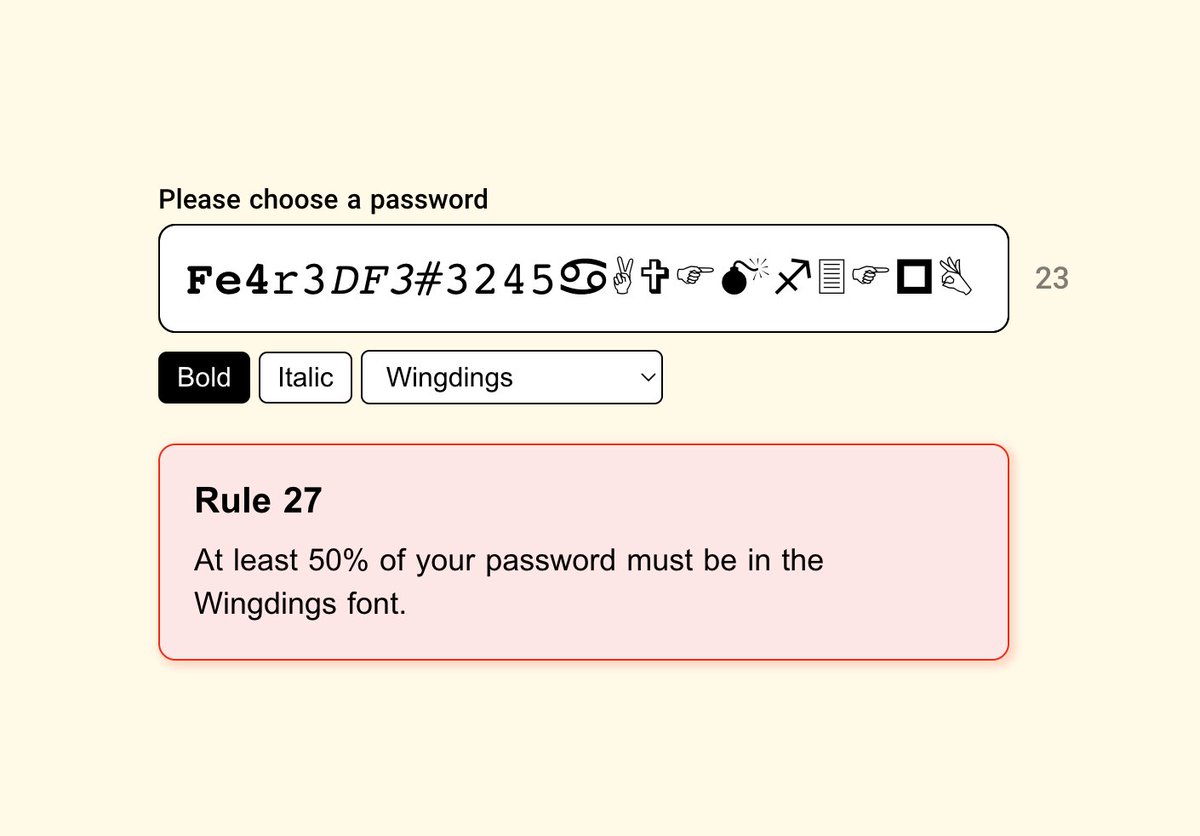
Working on a password game with increasingly unhinged rules.

what are some rules I should add?

Image

May 22, 2023

Originally posted by Freya Holmér also in: twitter.com

I am so grateful wikipedia still exists, it’s nothing short of a miracle in today’s internet

May 21, 2023

What is “accessibility”? For some, it’s about ensuring that your sites and apps don’t block people with disabilities from completing tasks. That’s the main part of it, but in my opinion it’s not all of the story. Accessibility, to me, means taking care to develop digital services that are inclusive as possible. That means inclusive of people with disabilities, of people outside Euro-centric cultures, and people who don’t have expensive, top-the-range hardware and always-on cheap fast networks.

In his closely argued post The Performance Inequality Gap, 2023, Alex Russell notes that “When digital is society’s default, slow is exclusionary”, and continues

From Bad performance is bad accessibility by Bruce Lawson

May 20, 2023

It turns out that Large Language Models are pretty decent planners. As Auto-GPT (GitHub) shows, you can give an LLM a goal, and have it auto-expand that goal into a sequence of steps. And that, given some basic plug-ins, start executing those steps with external tools.

But (having been one) 14 year old boys are idiots, and perfectly capable of typing “let’s do this idiot nation-destroying thing” and leaving the AI running overnight - and you can’t monitor them all. The main hurdle for 14 year old boys doing idiotic things is simply lack of opportunity and not knowing where to start. AI “fixes” that.

From The 14 year old boy alignment problem, future shock, and AI microscopes by Matt Webb

May 18, 2023

In general, if your design relies on having a client protect a secret from a local attacker, you’re doomed. As eloquently outlined in the story “Cookies” in 1971’s Frog and Toad Together, anything the client does to try to protect a secret can also be undone by the client:

“Trying” isn’t entirely madness — believing that every would-be attacker is “sufficiently motivated” is as big a mistake as believing that your protection scheme is truly invulnerable. If you can raise the difficulty level enough at a reasonable cost (complexity, performance, etc), it may be entirely rational to do so.

From (The Futility of) Keeping Secrets from Yourself by Eric Lawrence

May 15, 2023

Web performance is an unalloyed good. No one has ever complained that a website is too fast.

So the benefit is pretty obvious. Users like fast websites. But there are other benefits to web performance. And they don’t all get equal airtime.

With every file you add to a website’s dependencies, you’re adding one more barrier. Eventually the barrier is insurmountable for people with older devices or slower internet connections. If they can no longer access your website, your website is quite literally inaccessible

From The intersectionality of web performance by Jeremy Keith

May 15, 2023

Ah, but when it comes to front-end development, assumptions are like little hidden bombs just waiting to go off!

I’m very grateful that they brought the issue to my attention. If they hadn’t, that assumption would still be lying in wait, preparing to ambush someone else.

From Assumption by Jeremy Keith

May 15, 2023

No. Progressive enhancement means making sure your core functionality works without JavaScript.

Without JavaScript I should still be able to read my email in Gmail, even if you don’t let me compose, reply, or organise my messages.

Without JavaScript I should still be able to view a document in Google Docs, even if you don’t let me comment or edit the document.

Even with something as interactive as Figma or Photoshop, I think I should still be able to view a design file without JavaScript.

From Read-only web apps by Jeremy Keith

May 14, 2023

A person being able to modify an experience so it suits their specific needs is one of the web platform’s greatest strengths. You shouldn’t attempt to block, subvert, or otherwise undermine someone’s ability to do so.

Test actual support with different operating systems and modes other than the ones you use on a daily basis. Remember that the way you use technology is not the default, and that the majority experience is a contradiction in terms.

You don’t get to pick who visits your website or web app, what their circumstances are, or how they choose to interact with your content. Choosing not to mess with the browser’s scrollbar is a simple, yet powerful thing you can do to help ensure people can get what they need.

From Don’t use custom CSS scrollbars by Eric Bailey

May 14, 2023

I just don’t buy a lot of stuff. I’m not interested in lifestyle products and tastemaker brands. When I do buy something, it’s usually something I need - as in, not frivolous luxury spending (though I’m certainly not immune to this behavior). I typically won’t replace something unless it’s broken beyond repair.

I fear the day my TV gives up, because you can’t seem to buy one without the smart anymore.

There are so many touchscreens in my life now that I’m starting to get dull aches in my fingertips. Gone is the satisfying tactile response of mechanical buttons and knobs. My induction stovetop requires incessant thumb mashing just to raise the temperature a few notches. If a small amount of water falls on it, it starts beeping. This is in absolutely no way an improvement over my old mechanical one with ceramic hotplates.

In fact, for every improvement in speed, energy consumption, image resolution or audio fidelity, there seems to be a tradeoff in increased frustration: input lag, incessant bickering about connecting to WiFi, and ever more contrived software mechanisms designed to make me watch ads. I’m old enough to remember both software without built-in marketing schemes and TV:s that turned on instantly and switched channels in the blink of an eye. Streaming services may give better image quality than an old VHS player, but the VHS had zero boot time and never required you to enter a password using a flimsy remote.

Nobody wants it, because nobody buys it, because one day, all of a sudden, it just wasn’t for sale anymore.

Curiously, there’s still a booming market for these products, because several specialty online stores do sell them. The difference is that instead of just grabbing these items when also getting a carton of milk, I now have to keep track of my consumption rate, plan and place online orders on sites of dubious usability, and deal with the erratic behavior of delivery companies. Small inconveniences, sure, but ones that add up to quite a long list of similar small inconveniences.

From overly enthusiastic store clerks to contrived online tracking, marketing blatantly disrespects my privacy and pollutes my brain. It’s not just that it tries to make me buy things I don’t need, it’s that it makes my quality of life noticeably worse in the process. I like peace and quiet. I like thinking, eating, relaxing, reading, socializing - existing - without constant interruption

On the rare occasions I do catch a glimpse of a TV commercial, it’s by mistake. Usually it’s when someone not running an adblocker wants to show me something on their computer, or when I visit someone who watches broadcast TV. Every time it happens, I’m surprised by how many ads there are and how brazen, repetitive and disgusting they come off.

From A Life Less Ads by Carl Svensson

May 13, 2023

In a world awash with software whose shelf life approximates that of my grocery store milk, I love that there is no semver to worry about on the web — HTML5, CSS3, ES6, these are not major breaking changes.

However, as Chris points out, all of those features are a accretion to the language. “Don’t break the web” means we don’t have to worry about reading CSS release notes like, “🚨 Breaking changes: float has been replaced by flex. You must upgrade to newest version.”

But how long can we reasonably go without removing the old? How viable is this approach over time? 100 years from now, will people still be able to write float in their CSS?

I don’t know how the web will evolve over time to deal with what — I assume? — will inevitably become a problem of incomprehensible complexity resulting from decades of language accretion (like stalagmites in a cave).

From Gratitude For a Web That Tries Not to Break by Jim Nielsen

May 13, 2023

Google is a portal to the web. Google is an amazing tool for finding relevant websites to go to. That was useful when it was made, and it’s nothing but grown in usefulness. Google should be encouraging and fighting for the open web. But now they’re like, actually we’re just going to suck up your website, put it in a blender with all other websites, and spit out word smoothies for people instead of sending them to your website. Instead.

And while doing that, they aren’t:

  • Telling authors their content is being used to train
  • Telling users where the output came from
  • Offering any meter of how reliable or confidently correct the output is

So, I’m critical. It’s irresponsible.

From “the secret list of websites” by Chris Coyier

May 13, 2023

In “Magic Mirror: The Novel as a Software Development Platform”, Mark Pesce eloquently argues that the developments we see in modern technology are predicted (if not determined) by science-fiction stories (Pesce, 1999). As a note of caution, Pesce’s chosen examples all display the traits of survivorship bias. That is, there are an infinite number of “inventions” in sci-fi which have not come to pass. Given the long history of the genre, it is not surprising that some of its predictions have become reality. Nevertheless, it is important to remember the “anchoring” effect that mass media has on users’ perceptions of what is possible with technology.

Technology companies frequently misappropriate terms from science fiction in order to make their products sound innovative and exciting (Newitz, 2021). The original Metaverse envisioned by Stephenson was a dystopian nightmare. It serves as an allegory for how the worst excesses of humanity can corrupt an environment. Similarly, the novel “Ready Player One” presents a world where VR has reduced the majority of humanity to serfdom (Rafif and Munjid, 2022). Given this, the author finds it inexplicable that Facebook chose to rebrand their company around the notion of the Metaverse. It is akin to a military power rebranding to be closer associated with The Empire from Star Wars, or a conglomerate explicitly citing the “Weyland-Yutani Corporation” from Alien as their inspiration.

Future-gazing sometimes means imagining the worst-case scenarios which may be exploited by future adversaries. There is an inherent tension in this line of research. If the futurist publishes their research, a malicious user may take inspiration from their research. But if the futurist does not publish, people may not be able to defend themselves against novel attacks.

From Rejected Sci-Fi Ramblings from my MSc by Terence Eden

May 13, 2023

I’ve been reading various entrepreneur books and blog posts. One thing they all emphasise is that success often comes from finding a problem that you yourself would pay money to solve.

And that’s a problem for me. I don’t tend to want to spend money solving problems.

I’m not claiming to be a hermit, but I find it weird just how little cash I’m willing to part with to improve my life. So I’m stuck trying to work out what services I would pay a small business for.

When it comes to software, I’d rather write my own or fiddle with open source. I’m aware this means I value my time poorly.

From How can I have a side hustle when I don’t want to pay for anything? by Terence Eden

May 13, 2023

In its README, it said that if I wanted to opt-out of having this particular tool scrape my images, I had to add some non-standard headers to my site. There was no way to opt-in to the bot.

It seems that every few years we have to have the same argument. Someone releases a tool on the Internet and claims that, if you don’t want to participate, you must explicitly opt-out.

It isn’t hard to see why that’s an obnoxious idea. Thousands of tools are released every day. Am I expected to play whack-a-mole and shut down every new one that appears? That is a perverse way to expect people to behave. These bots cost people time and money without offering any tangible benefit.

By analogy, I can’t suddenly declare that everyone online has to pay me £5 - oh, you don’t want to? Sorry, you should have opted-out last month. That’ll be a fiver, please.

Me asking for a tool to respect the consent of users is, apparently, an ethical crime against people who might benefit from whatever the tool could create in the future. That’s some “For The Greater Good” shit!

Different cultures have different ethics and one of the problems with the Internet is that we occasionally butt up against different norms of behaviour. But I think, in all cultures, you can’t just start grabbing a person’s stuff and then say “but you didn’t explicitly say that I couldn’t! Besides, it’s for your own good!!”

From Silence Isn’t Consent by Terence Eden

May 13, 2023

Again, I remember spending so much time trying to get a login form working with JSP. I don’t recall there being much error feedback either. It was like the thing worked or… blank page.

When I would add HTML and CSS to a page, I would get instant feedback. I would add the code, and things would appear on the page. They may not have looked exactly right, but they were there, giving me clues as to whether I was on the right track. I was hooked.

I’m sharing all this to say that if you want to learn how to code or be a developer of any kind, how important it is to find the technology and feedback loop that tickles your brain in just the right way. That allows you to create something that inspires you to keep learning and build your confidence.

I just needed to find the right context in which I could learn programming. My wish is that everyone else who is struggling can do the same.

From Find your feedback loop by Rach Smith

May 13, 2023

Originally posted by Chris Hannah

I was browsing Hacker News just now, and I came across an interesting question asked by user l2silver:

[What is the] most interesting tech you built for just yourself? - Hacker News

It’s an interesting question, and I’m sure a lot of tech people could some up with something interesting. But probably none as delightful as this answer from sriram_malhar:

My MIL is 93, and the only tech she can really deal with is turning on the radio and TV and changing channels.

She is fond of music from old classics (from the 60’s and earlier), so I hooked up a Raspberry PI with an FM transmitter and created her own private radio station. She tells me what songs she likes and I create different playlists that get broadcast on her station. It preserves the surprise element of radio, and there is nothing in there she doesn’t like.

The tiny FM transmitter is surprisingly powerful. Her neighbours (of similar vintage) are very happy too, so their requests have also started coming in :)

Now, that’s personal tech. My favourite part of it is that it still preserves the feeling and spontaneity of listening to radio. Perfect solution, and requires no extra learning at all!

This was originally posted in Personalised radio station by Chris Hannah but its a beautiful story to be shared again in its complete form.

May 12, 2023

Originally posted by Chris Heilmann codepo8@toot.cafe also in: twitter.com

OK, those who follow the teachings of the good book (HHGTTG) know that 42 is the answer “life, the universe and everything”. But here’s where it gets really geeky: the ASCII code of *, the placeholder character for everything is also… 42.

May 6, 2023

So, back to the Web. My blog is something I own, I can shape it however I want, I already have an audience for it, and I’m the admin. Everyone is already familiar with the concept of sharing web links, so there’s no learning required from anyone. You know what, the web is still awesome at letting you share long-form documents. That was it’s original purpose, so let’s do this!

From Back to the Web by André Staltz

May 4, 2023

Cool! I’d expect it to, and I’m sure it can even provide you some really good information. That is, if you know what to ask and know how to interpret what it returns to you. My 10 year old can also provide some very detailed information about what I do for work. About half of what she would say is true, and the rest is generally vauge and plausible enough that, sure, I have trained a shark to help blind people read the web. Why not. My 7 year old just thinks I drink coffee and write emails. Again, partially true. I’m going off topic…

My point is that this technology is still rather young, and what it regurgitates to you is going to be based on what it’s learned from humans, who are also unfortunately often incorrect. Some may acknowledge these gaps, but still assume ChatGPT could provide people with at least baseline information to start learning about aspects of web accessibility. Or at least, provide you accurate code guidance to help build accessible websites.

As with the authenticity of my kids’ answers, there is some truth to that, so long as you know that this can give you a start, but you should be mindful and question each answer it provides you

But, it is going to need some corrective training to help it unlearn all the junk it has picked up so far. I mean, it’s learning from what we’ve written on the Internet. We can’t get upset, and we should KNOW to expect such information gaps and lack of understanding, since its just recycling what we have collectively fed it. It’d be foolish to think it knows better than what it has learned from us.

From Setting expectations for asking ChatGPT web accessibility questions by Scott O’Hara

May 2, 2023

Originally posted by Halli also in: twitter.com

Let people do silly things that make no sense. The sillier the better. The nosenseier the better.

Not everything we do should be to increase the GDP. In fact, most of the things we do shouldn’t increase GDP.

Being alive should be a celebration of random silliness.

May 1, 2023

We obsessively optimise when it comes to scripts, styles, and other resources; interestingly, that doesn’t always apply to HTML. In the case of single-page apps, it may feel like you stand to gain more in performance if you focus on JavaScript. In the case of server-rendered, non-interactive sites, some people doubt that the performance impact of a large DOM is noticeable.

We also lack the required tooling: according to Jens Meiert, not enough HTML minifiers prune optional HTML tags and default attributes. When it comes specifically to unneeded wrapper elements, tooling wouldn’t help us anyway (you would need a pretty sophisticated analysis of the associated styling to determine if an element can really be omitted).

Finally, working with deeply nested DOM trees just slows you down. […] Debugging becomes harder, tracking down nodes in the inspector becomes more tedious, and the joy of the craft is diminished.

From Fighting inter-component HTML bloat by Elise Hein

If we can use our design systems to speed up meaningful work, standardise things to a high quality, and scale the things we actually want to reproduce — then the reverse is also true. It means that we can also use our design systems to speed up problematic work, standardise things to a poor quality, and scale things we don’t want to reproduce.

From Building conscious design systems by Amy Hupe

May 1, 2023

The slowness in our tooling wasn’t caused by JavaScript the language, but by things just not being optimized at all.

From Speeding up the JavaScript ecosystem - module resolution

Based on these numbers I’m fairly confident that we can get very close to rust’s performance with just JavaScript based on this little experiment.

From Speeding up the JavaScript ecosystem - eslint

Engines are pretty good with loading big blobs of JavaScript. The main reason we care so much about file size on the web is the cost of having to deliver those bytes over the network.

From Speeding up the JavaScript ecosystem - npm scripts

All by Marvin Hagemeister from the same series. Amazing reads showing how javascript can be fast if you know what you do.

April 30, 2023

My favorite part of the documentary is Megan Smith beaming over her cabinet full of hardware prototypes. Her focus on making something people love, an intimate device, is infectious. Her eagerness to blend everyone’s wishes with the harsh reality of available and affordable hardware shows. Starting with off-the-shelf components and inventing if necessary. When describing the product, she’s not talking about megabytes, protocols, and pixels, but talking about the sound, the feeling, the touch of the product and software in people’s hands.

I feel more vindicated than ever that prototypes, put in people’s hands, are the biggest opportunity to capture lightning in a bottle. These people are imagining and building the iPhone 17 years before the iPhone launched. Megan Smith talks like Steve Jobs, but Steve Jobs doesn’t work at Apple or General Magic. We often herald the invention of the iPhone or Android and these magic devices as invented out of thin air or our collective science fiction, but both of those products used by billions of people rose from the ashes of General Magic’s failure. That’s a lot to dwell on. The composting of failures produces rich and fertile soil.

From Megan Smith explaining the General Magic prototyping process by Dave Rupert

April 29, 2023

Perl had now been replaced with PHP and flat files with MySQL, and the job was truly what you’d call full stack development. All of us did everything, from compiling Apache, PHP and MySQL on freshly installed Slackware boxes, to designing databases, coding PHP and churning out HTML. Deployment was simply a matter of uploading the files from your local machine to the production server.

Testing? Maybe banging the keyboard a bit to see if your forms validated reasonably, but not much more than that. Truth be told, I couldn’t program to save my life. I - well, we - committed many grave and terrible sins. SQL injection mitigation? Please, this was the time of the honest web. Who would even try something so sinister?

The daily work was mostly routine churn: HTML forms submitted to a PHP backend, saved in a MySQL database. These were simpler sites for simpler times: a single person could easily write, understand and manage the code, database and daily running of what was at this time considered a state of the art web shop. JavaScript was maybe used for mouseover effects or scattered lines of glue logic - after all, the biggest competitor to Netscape 4 was, at this point, Netscape 3.

Much like how Commodore 64 programmers could keep a map of the entire computer in their head, a moderately competent developer could churn out an acceptable web site in a matter of weeks, understand every single aspect of it and get paid in the process. If I, a quarter century ago, had possessed the experience and knowledge I do now, the simplicity of those early web pages would’ve felt surreal. And yet, we apparently provided a service that was of some value to some people. A digital commodity, nothing more, nothing less. Actually useful software.

For quite some time, this complexity has served us well. It has made life copiously more endurable and rewarded us with great material wealth. Small wonder, then, that we want to squeeze every last drop from it. Sure, your electric toothbrush really shouldn’t require firmware upgrades, but there’s a buck to be made in all kinds of planned obsolescence. Web sites don’t need tens of megabytes of ads and tracking scripts to function, but someone is still paying for those sweet, sweet data points at which to target ads. It’s most certainly a strange idea to run a text editor inside a bundled web browser - but that way it’s easier to build for more platforms and you can even hire simpletons like me to write much of the code for it. And since more software is produced than ever, more bad software is also produced than ever before.

From A Quarter Century of Web Coding by Carl Svensson

April 29, 2023

Originally posted by Freya Holmér also in: twitter.com

every year I’m reminded of the massive cultural loss we suffered with the death of flash

it was so ahead of its time, there’s still no replacement for the creative space it once occupied for artists, animators, and game devs

April 26, 2023

There’s truth to that! I too have a great dissatisfaction with the recommender systems available to me. But I suspect that many who dismiss algorithms outright are throwing the baby out with the bath water. Chronological feeds are dominated by those who post frequently, and building an audience from scratch can take years. Recommender systems can help to solve problems like these.

In reality, I don’t think people actually want “full control” over what they read, because that’s too much work. What people are more likely to do is over-subscribe themselves, feel overwhelmed and stagnated in their content diet, and move onto a new platform if the old one doesn’t solve their problem for them. I don’t think most people are interested in painstakingly curating their feeds.

Recommendation doesn’t have to be just a tool that big tech companies use to make a number on a spreadsheet go up. How can we develop algorithms that serve the interests of individuals?

From In defense of recommendation by Jacob O’Bryant

This is something that i’ve been looking for a while. I dont think algorithmic timelines are bad as long as they only recommend things from the feeds you are subscribed and using your own thumbs-(up/down) to train that recommendation. Sometimes i have a lot of unread articles, and i dont have the energy to skim through titles, i just want a kind of “top 5 suggested based on your previous votes”.

April 25, 2023

[…] But even if we restrict our focus to those who want to be founders, the reality is that it can take years for a nascent idea or desire to mature into a real business. YC may be focused on early-stage companies, but sometimes even an early-stage company takes a long time to build.

This has been workable in my case, but it points to a lack of institutional support. Not everyone has the resources (or stakeholder buy-in) to take a 4-year sabbatical. We have institutional support for research—what if there was something like “going to grad school,” but for open-source developers? Could it be scaled up enough so that people can actually get in without applying 8+ times?

From Funding software innovation by Jacob O’Bryant

April 24, 2023

What this centralization means in practice and whether, for example, the US government could realistically exert control over the root operators and companies discussed here, is a different story altogether. But no matter how you look at it, the internet seems less distributed or decentralized than one might wish, as many businesses and organizations appear to concentrate in a handful of registries and cloud service providers. We don’t have a single point of failure just yet, but I do see multiple points of calamity with increasing blast radius…

From Who controls the internet? by Jan Schaumann

So all in all, the answer to the question of who can read your email pretty much boils down to – yep – “Google and Microsoft”. Even if your domain doesn’t use one of their mail servers, chances are that whoever you are sending mail to does. To be fair: these companies are going to be doing a much better job at running and securing your email than you are, and outsourcing this critical functionality often makes good sense. And yet, this is another example of the continuously increasing centralization of the internet. Our businesses, just like our personal online lives, are concentrated in the hands of just a few companies.

From Who reads your email? by Jan Schaumann

April 23, 2023

On the weekend of July 4, 2014, Brian Mayer launched a website which listed reservations for sale to popular restaurants in San Francisco. The price of each reservation was a sliding scale, based on how in-demand the restaurant was. But Brian Mayer didn’t own or run any of these restaurants. He didn’t work for or with them. He had simply called the restaurants up weeks in advance, booked a whole lot of reservations under assumed names, and then put them up for sale without the restaurant’s permission. He called it ReservationHop.

[…] He cited other examples of websites that circumvent or otherwise ignore the norms, ethics, and laws tied to those interactions, sites like MoneyParking, which let users auction off parking spots they had no legal right to, and Enq, which ties up IRS phone lines so they can sell that spot to the highest bigger, Doctrow claims that the end goal is “Markets in everything!”

From Web Products Everywhere by The History Of The Web

April 19, 2023

Originally posted by Emma Bostian also in: twitter.com

Can we stop pushing the narrative of “this topic has already been taught in courses before, we don’t need another course/blog/etc. on this topic.”

So what?

That’s like telling an author “there are already thousands of murder-mystery novels, your book is worthless.”

April 18, 2023

Time Sense is a wearable sensory headband which allows the wearer to feel the passing of the 24-hour clock around the circumference of the head. As the day progresses, a tiny heat sensation passes the length of the headband.

Also

[…] it allows him to feel and hear colours as audible vibrations inside his head, including colours invisible to the human eye such as infrareds and ultraviolets.

The UK national electrical grid delivers power across the country. This mains power supply makes a constant humming sound, yet there are tiny changes to the frequency of this sound every second. Most recordings made in the UK have a trace of mains hum on them and this can be forensically analysed to determine the time and date they were made, and as a result, whether anyone has edited the recording.

From Filtered for clocks by Matt Webb

April 16, 2023

All of this is to say that open source has absolutely nothing to do with being cloned. Open source licenses will not save you, copyright won’t save you, patents will not save you: if you have a successful product it will get cloned. This is inevitable and trying to prevent it is a waste of your resources. Not even the almighty Apple can prevent the mass cloning of the AirPods.

From A reply to Josef Průša by Stargirl Flowers

April 16, 2023

The simple power of a URL is that anyone can click it and instantly access it. All you need is a browser. There is no need to install an application or worry about what operating system you are running on.

A quote from Thomas Nattestad in Photoshop’s journey to the web

Web applications are inherently universal. They run on whatever operating system is capable of running a Web browser and they do not need to be compiled for each operating system separately. The same code base powers the application on all platforms. This does not mean that there are no compatibility issues—there are plenty actually—but there is a solid, shared, increasing baseline that all applications can build upon.

Investing in a memorable domain name can sometimes actually be better for discoverability. Even for app stores, people still rely most on recommendations from friends and family members to discover new apps according to research done by Google.

The tooling and framework situation in the Web development world is infamous for being confusing and hard to keep up with. In practice, though, companies would use one technology and tooling stack and stay true to it for many years. The world of tech Twitter is one thing, the reality in businesses, where the decades-old jQuery is still (and by a large amount) the most popular framework, is the other.

Web applications have seen impressive performance improvements thanks to advanced technologies such as WebAssembly (including SIMD), WebGPU, and general JavaScript engine progress in recent years. Nonetheless, a carefully developed, platform-specific app will typically outperform a Web-based application (albeit the situations where this actually matters may be limited). With even high-performance audio-editing tools like Soundtrap (thanks to the Web Audio API and AudioWorklet), interactive development environments like Jupyter Notebook, and graphics-editing tools like Figma (thanks to WebAssembly), and of course graphics-intensive games like Quake (thanks to WebGL and WebGPU in the future), the boundaries are being pushed at a rapid rate.

From Not everyone’s currently building for the Web, but probably more people should by Thomas Steiner

April 16, 2023

So, has Open Source won? Mostly, I’d say. At the very least there are good Open Source alternatives to nearly every programming language and paradigm. There are some niches - science, finance, gaming - which rely on proprietary languages. And Cloud services run custom software on their custom OS running on custom processors. The new paradigm of LLM AI might eventually be fully open, but rely on processing power so out of reach of mortals that it might as well be closed.

From Are there any modern closed-source programming languages? by Terence Eden

April 15, 2023

Why write an essay when you can type a few words and have AI generate one for you? Why write an email when AI can auto-respond for you with all the typical pleasantries and talking-points? While AI doing these things for you is likely to happen, it’s not necessarily a good thing. Even when these tools exist, they are not a replacement for writing. Writing is the process by which you realize that you do not understand what you are talking about. Importantly, writing is also the process by which you figure it out.

From AI: Do we really “get it”? by Anton Sten but is quoted from Why Write?

April 15, 2023

Experiments like Arc feel like they could have more in common with tools-for-thought software like Obsidian and Roam Research. Those tools build knowledge graphs of connected nodes. A kind of hypertext of ideas. But we’ve already got hypertext tools we use every day: web browsers. It’s just that they don’t do much with the accumulated knowledge of our web browsing. Our browsing history is a boring reverse chronological list instead of a cool-looking knowledge graph or timeline.

From Browser history by Jeremy Keith

April 14, 2023

You don’t have to prove everything. Sometimes you gotta follow what’s interesting, follow your gut, even if you can’t immediately measure it and extrapolate it to a theory. If it proves to work, that’s its own metric, however opaque the mechanics.

From AI & The Science of Creativity by Jim Nielsen

April 14, 2023

And this idea of AI making you “more collaborative in Teams”? Collaboration is about relational exchanges, cooperation, and connection. Writing a product strategy update for your team takes into consideration the individual circumstances, unspoken doubts, and historical context of the individuals on your team — not just the emails and messages the computer parsed (AI can’t synthesize what hasn’t been captured).

The most rewarding work I’ve done always originated outside of my tools. My satisfaction of feeling collaborative, or creative, or expressive, or ____ came about first outside any given tool.

From More Everything With AI by Jim Nielsen

April 12, 2023

A single ant eats about 2mg per day according to a random website, so you could support a colony of a million ants with 2kg of food per day. Supposing they accepted pay in sugar, or something similarly expensive, 2kg costs around $3. Perhaps you would need to pay them more than subsistence to attract them away from foraging freely, since apparently food-gathering ants usually collect more than they eat, to support others in their colony. So let’s guess $5. My guess is that a million ants could do well over $5 of the above labors in a day.

How do you hold an ant accountable if they fail to deliver on a contract? Do individual ants even have agency? Can we require an ant colony to purchase public indemnity insurance?

So while we, in the 21st century, are tying ourselves in knots trying to figure out the appropriate remedy when civil unrest caused by a social media app leads to deaths, maybe in Athens how ever many millennia ago they simply would have sunk a few of the servers in the Aegean.

From Filtered for ants and laws by Matt Webb

April 11, 2023

There used to be a salmon smokery in north London. Aside from the juniper and beech wood, Ole Hansen (proprietor) would, once a day, sit down and play piano to the hanging fish – live jazz and occasional singing.

Last September, Swiss cheesemaker Beat Wampfler and a team of researchers from the Bern University of Arts placed nine 22-pound wheels of Emmental cheese in individual wooden crates in Wampfler’s cheese cellar. Then, for the next six months each cheese was exposed to an endless, 24-hour loop of one song using a mini-transducer, which directed the sound waves directly into the cheese wheels.

Let’s take hip-hop ovens to CES 2024 by Matt Webb

April 11, 2023

YET – I find myself labelling this task as a failure of the industrial design. Oh, the charging port gets fluff in it! Get rid of the port! Invent a whole thing for wireless charging! Which is a shame. Because in other worlds it is a marketing benefit to use oil in your car that makes it run better over time. It is a pleasure - and a performance benefit - to oil a cricket bat, or wax a violin bow, or season an iron pan. A vocation to prune a bonsai.

“if you don’t fix something when you first see it beginning to fail, it is very likely to finish failing just when it is the most dangerous and the hardest to deal with, such as in the midst of a storm.”

From Don’t bother me now I’m waxing my phone by Matt Webb

April 11, 2023

So my theory is that AI finger mistakes are actually representative of the pre-tetrapod transition 7-fingered body map buried deep in the collective unconscious, now unearthed by LLM gestalts.

And it points out that kisses now needn’t be synchronous. Async kisses could, I suppose, be recorded, replayed, traded, added to the permanent collection of the museum of kisses of famous smoochers (perhaps), pirated!, kept for lending in a nationwide state-run kissing library, etc. Deepfake kisses would enable kissing inaccessible celebrities (ick) or people from long ago or fictional people. Or what if the AI boffins at DeepMind got their hands on this. AlphaGo, AlphaProteinFolding, AlphaSnogs. The Kasparov/Deep Blue moment. 2024 will be the final year that humans are better than computers at kissing, what then.

Filtered for causes and kissing by Matt Webb

April 12, 2023

Originally posted by Henri also in: twitter.com

For anyone who missed the lofi girl’s countdown and the boy’s intro

Image

April 10, 2023

Instead - I think most people would be better served by subscribing to small b blogging. What you want is something with YOUR personality. Writing and ideas that are addressable (i.e. you can find and link to them easily in the future) and archived (i.e. you have a list of things you’ve written all in one place rather than spread across publications and URLs) and memorable (i.e. has your own design, logo or style). Writing that can live and breathe in small networks. Scale be damned. When you write for someone else’s publication your writing becomes disparate and UN-networked. By chasing scale and pageviews you lose identity and the ability to create meaningful, memorable connections within the network.

Forget about “visibility” for your post. The unit of blogging isn’t pageviews, it’s conversations.

From Writing, Riffs & Relationships by Tom Critchlow

April 9, 2023

When it comes to day-to-day production code, here’s the barometer I like to use: will a junior developer, someone at the very start of their career, struggle to understand this code? In the context of a shared codebase, good code is simple code. Code that doesn’t do anything fancy. Code that makes minimal use of abstractions. Code that you’d use to explain fundamental concepts to novices.

If the goal is to reduce complexity, and abstractions add complexity, should we abolish abstractions altogether? Well, no. Abstractions are everywhere. Loops are abstractions. Functions are abstractions. Programming languages themselves are abstractions over machine code, which itself is an abstraction over transistors flickering off and on really fast. It’s abstractions all the way down. The key is to weigh the cost of an abstraction against its benefit.

From Clever Code Considered Harmful by Josh Comeau

April 9, 2023

Originally posted by @mia@front-end.social also in: twitter.com

Large companies find HTML & CSS frustrating “at scale” because the web is a fundamentally anti-capitalist mashup art experiment, designed to give consumers all the power.

Sorry I didn’t quote tweet anything in order to say that.

April 9, 2023

For example: imagine for a moment the value of google.com. What would that domain cost? People’s entire personal and professional lives — email, photos, calendar, documents, etc. — built up over years and years, solely accessible at that domain.

Now imagine someone who invested years of their life creating value for others and amassing a following on Twitter. They now face a dilemma: all that value lives at a URL they can’t control twitter.com/{username}. Even the word-of-mouth username is something they have zero control over.

However, if own your domain, create value there, and drive people to it, you’re paying ~$10 a year to build unbounded value over the years — value you control.

That is why owning a domain (and publishing your content there) is like planting a tree: it’s value that starts small and grows. The best time to own a domain and publish your content there was 20 years ago. The second best time is today.

This is the what I love about rel=me: it reinforces the value of owning a domain that people respect and trust because, through the years, it becomes a source of quality information. In an internet connected world, domains are a currency of value. Do you want to own your value, or let someone else own it?

From The Best Time to Own a Domain Was 20 Years Ago; The Second Best Time Is Today by Jim Nielsen

April 9, 2023

Early cartridge and disk-based games have been fairly easy to preserve. If you have an NES and a game cartridge, you can play the game. But this is not possible for iPhone apps. To run an old iPhone app, you’ll need an older device and the related cloud services to be running as they were at the time.

Modern software is in a strange place where it’s more at risk of being erased from history than software created in the pre-internet era. Everything we work on is so incredibly ephemeral.

From Celebrating App Icon Design by Michael Flarup

This struck me as intriguing. To run an old game, you need the hardware (console) and the software (game cartridge). But with the interconnected, interdependent nature of so much software today, you not only need the hardware and the software, but also all the cloud services the software depends on.

From Digital Preservation and “The App Icon Book” by Jim Nielsen

April 9, 2023

Large companies find HTML & CSS frustrating “at scale” because the web is a fundamentally anti-capitalist mashup art experiment, designed to give consumers all the power.

From this tweet by Miriam Suzanne

I still find it fully miraculous that webpage source code is freely viewable, and browsers allow for trivial editing of the source live and inline. Can just imagine the pushback against if someone tried to launch a platform like this today

From this toot by Craig Mod

It’s quite incredible that the money and power birthed through the advent of the web haven’t yet been able to completely overtake this “mashup art experiment” medium which “gives consumers all the power”.

All quotes from The Anti-Capitalist Web by Jim Nielsen

April 6, 2023

All computing is to some degree artificially intelligent. At one point a TI-83 calculator was artificial intelligence. When Google search first came out it was artificial intelligence. Frankly, a modern refrigerator counts as artificial intelligence: it’s programmed to achieve an objective by taking action and uses environmental feedback to adjust its behaviour. These things are now so banal and pervasive we are unimpressed by their “intelligence.”

From Empty Pointers and Constellations of AI by Maggie Appleton

April 6, 2023

Originally posted by CSS-Tricks also in: twitter.com

The web is lots of things. Very good things. Versatile, Decentralized, Resilient, Responsive, Adaptable, Accessible, Inexpensive, Diverse, Standardized, and Open. Makes ya proud to work on it sometimes, doesn’t it?

What the Web Still Is by @ericwbailey https://css-tricks.com/what-the-web-still-is/

April 6, 2023

I think that’s one quality of a good old blog; reader agency. I remember late nights roaming through my favorite blogs and I’d find something, a small trinket of the tiniest little poem, from way back in 2002. And because there were no likes or comments or anything attached to the post, I decided it was important.

From Notes On Hypertext by Robin Rendle

April 4, 2023

It’s neat to ponder over how for however many people you know about from their internet presence, there is a sort of “dark matter” of other super smart people you never hear about. For one example I think of the very talented Antoine, author of gnarly comments like these and seniormost person on ChromeOS, who appears to be otherwise mostly invisible on the internet.

I mention this because when we learned we got the award, and each person was told how much they would get, one of the most senior people on the team announced soon after that he was leaving the company. I remember being surprised by it and asking him about it. His response has stayed with me, something along the lines of: “Once I knew the highest upside I would get for staying, I could better evaluate it against my other options.” I think there’s a lesson there about how rewards can have the opposite effect you intend.

At one point the question came up: how many redirects should a browser follow? Say you try to load A, but it redirects you to B, which redirects to C, and so on; at some point you should give up and say something is broken. Someone picked some reasonable-seeming threshold, like 10 or so, after which Chrome would give up. Then Darin, who had previously worked on Firefox, said “no, it has to be 30, or it breaks the New York Times — I know this from experience”. (Today Darin is working on another browser, hopefully getting a third use out of that hard-won lesson.)

At the time I’d joke that “Chrome 12 [an old version] was the best Chrome”, but since I’ve come to see underneath that for me what I wanted was a fast tight browser, and once I had that, pretty much by definition most subsequent work was just gonna make it worse. Sure, there’s work like fixing rendering crashes or improving scroll performance, but most work involves adding features that make it bigger or slower.

Longer term, what I have come to appreciate about this is that I put a lot of myself into the product and I am proud of what I made at the time, but that product is a living thing that I do not control and it has gone on in directions I wouldn’t have taken it.

It’s also funny to reflect on how much time we spent agonizing over making the most minimal thing — Chrome initially had no “Home” button and I remember there being long arguments about whether adding it even as an option was contrary to the goal of the thing — vs today’s browser which is covered with buttons and settings, just like the browsers it was intending to revolt against.

All from Chrome, 10 years later by Evan Martin

March 26, 2023

Originally posted by Yuumei also in: twitter.com

I just want to smoosh my face into that neck floof.

#princessmononoke #ghibli #wolf

Image

March 24, 2023

Originally posted by Fox Pick 🦊 also in: twitter.com

First official preview of how PicTacToe works! Watch my 12 yrold niece in purple against my sister in red and yellow! #PicTacToe #LockPick

Image

March 24, 2023

Originally posted by agatha ✦ᴗ✦ also in: twitter.com

a tea break from the AI firehose

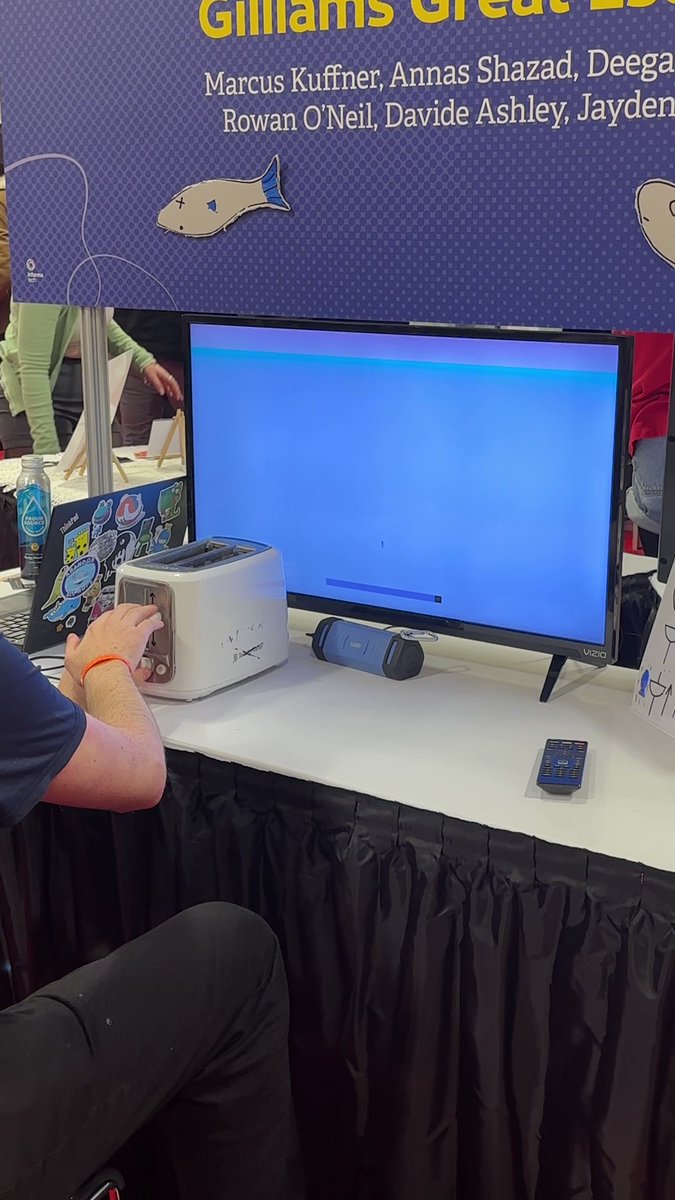
maybe all the years spent on designing and shipping touch controllers, should have worked on kitchen appliances ⏲️

Gilliams Great Escape, a game where you are golf-ing a fish with a toaster @Official_GDC 💜

Image